
Attention Metrics Are Replacing Impressions: How DOOH is Proving Real Audience Value
For years, advertising success has been measured by one dominant metric. Impressions. The more people who “see” an ad, the more successful a campaign is assumed to be.
But in today’s fragmented media landscape, that assumption is being challenged.
Consumers are exposed to thousands of ads every day, yet very few actually register. A digital ad may technically be “viewed,” but if it is skipped, scrolled past, or ignored, did it really have any impact?
This is where a major shift is taking place across the industry. Advertisers are moving beyond impressions and focusing on something far more meaningful. Attention.
And increasingly, digital out-of-home (DOOH) is leading the way.
The Problem with Impressions
Impressions have long been the standard currency of advertising, particularly in digital channels. But they come with a fundamental limitation. They measure opportunity to see, not actual engagement.
In reality:
- Ads can load below the fold and never be seen
- Videos can autoplay without sound or focus
- Users can scroll past content in seconds
This has created a gap between what is reported and what is actually experienced by the audience.
As a result, brands are starting to question the true value of high impression numbers, especially when they do not translate into recall, engagement, or action.
The Rise of Attention as a Metric
Attention-based measurement focuses on what really matters. Did the audience actually notice and process the message?
This includes factors such as:
- Time spent looking at an ad
- Visibility and screen placement
- Dwell time in the environment
- The likelihood of recall
Rather than counting exposures, attention measures the quality of those exposures.
This shift is being driven by a simple realisation. Not all impressions are equal.
A single moment of focused attention can be more valuable than hundreds of passive exposures.
Why DOOH Naturally Captures Attention
Digital out-of-home stands out in this new landscape because it is built for attention.
Unlike online environments where ads compete with endless content, DOOH exists in the real world, where context and environment play a critical role.
In environments such as petrol stations and mining sites, DOOH benefits from:
- High dwell time, where audiences remain in place for several minutes
- Limited distractions, compared to mobile or desktop screens
- Large-format displays, designed to be seen clearly
- Contextual relevance, aligned with the audience’s activity
This creates conditions where attention is not just possible, but highly likely.
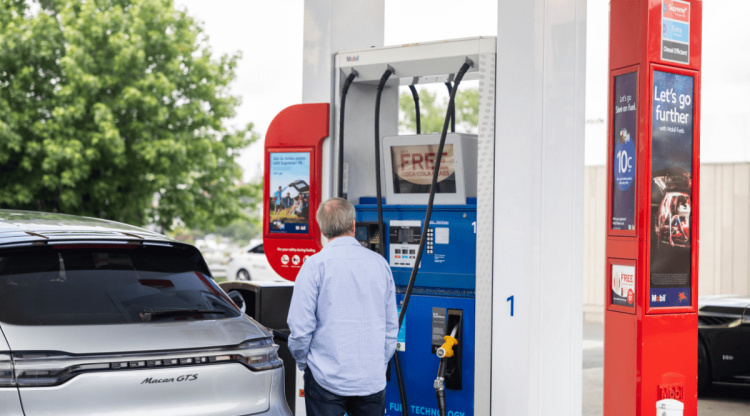
For example, a driver at a petrol pump is not scrolling through multiple feeds. They are stationary, with a clear line of sight to nearby screens. This results in longer viewing time and higher message retention.
Measuring Attention in DOOH
Advancements in technology are making it easier to quantify attention in out-of-home environments.
Advertisers can now access insights such as:
- Average dwell time at a location
- Visibility and screen impact
- Audience movement patterns
- Engagement based on contextual factors
In environments like petrol stations, dwell time alone can significantly increase the likelihood that an ad is seen and processed.
In mining environments, where workers repeatedly pass through the same locations, attention is reinforced through frequency and familiarity.
These insights allow advertisers to better understand not just how many people are exposed to a campaign, but how effectively that campaign is delivering value.
Attention Drives Real Outcomes
The shift toward attention is not just theoretical. It has real implications for campaign performance.
Higher attention levels are linked to:
- Increased brand recall
- Stronger message comprehension
- Greater likelihood of action
In other words, attention is a better predictor of outcomes than impressions alone.
This is particularly important in environments where decisions are made quickly.
At petrol stations, attention can directly influence:
- In-store purchases
- Brand choice
- Impulse buying behaviour
In mining communities, repeated attention can build:
- Trust
- Familiarity
- Long-term brand preference
A More Honest Way to Measure Value
One of the key benefits of attention metrics is that they provide a more transparent view of performance.
Instead of relying on inflated impression counts, advertisers can focus on:
- The quality of exposure
- The context in which ads are delivered
- The likelihood of real engagement
This helps brands make more informed decisions about where to invest their media spend.
It also levels the playing field between channels, allowing DOOH to demonstrate its true value compared to digital platforms.
What This Means for Advertisers
As attention becomes a core metric, advertisers will need to rethink how they plan and evaluate campaigns.
Key considerations include:
- Prioritising environments where attention is naturally high
- Designing creative that maximises visibility and clarity
- Measuring success based on engagement and outcomes, not just reach
DOOH, particularly in high-dwell environments like petrol stations and mining sites, is well positioned to deliver on all three.
The Future of DOOH Measurement
The evolution toward attention-based metrics is still ongoing, but the direction is clear.
We can expect to see:
- Greater standardisation of attention measurement across the industry
- More advanced tools for tracking and analysing engagement
- Increased demand for high-attention environments
As this happens, DOOH will continue to strengthen its position as a premium, performance-driven channel.
Final Thoughts
Impressions may tell you how many people had the chance to see an ad, but attention tells you how many people actually did.
In a world where consumers are overwhelmed with content, capturing attention is the real challenge and the real opportunity.
Digital out-of-home, with its ability to deliver messages in high-attention, real-world environments, is proving its value in this new era of advertising.
For brands looking to cut through the noise and drive meaningful results, the shift from impressions to attention is not just a trend. It is the future.