
The Cookieless Future is Here: Why DOOH is Becoming a Core Channel for Privacy-First Advertising
The advertising industry is undergoing one of its biggest transformations in decades. With increasing privacy regulations, the decline of third-party cookies, and growing consumer awareness around data usage, the way brands target and reach audiences is fundamentally changing.
For years, digital advertising has relied heavily on tracking individuals across the web. But that model is fading fast.
As advertisers search for effective, scalable, and privacy-compliant alternatives, one channel is stepping into the spotlight. Digital out-of-home (DOOH).
In a cookieless world, DOOH is not just relevant. It is becoming essential.
The End of Third-Party Tracking
Third-party cookies have long powered digital advertising, enabling brands to:
- Track user behaviour across websites
- Build detailed audience profiles
- Deliver highly targeted ads
However, this approach has faced growing scrutiny.
Consumers are increasingly concerned about how their data is used, and regulators are responding. Privacy laws such as GDPR and evolving global standards are placing stricter limits on data collection and tracking.
At the same time, major tech platforms are phasing out third-party cookies altogether.
The result is a significant shift. Advertisers can no longer rely on individual-level tracking as their primary strategy.
The Challenge for Advertisers
Without cookies, many of the tools that digital marketers depend on are becoming less effective.
This creates several challenges:
- Reduced ability to target specific individuals
- Less precise attribution and tracking
- Increased competition for first-party data
- Rising costs for digital performance channels
Brands are now being forced to rethink how they achieve relevance without relying on personal data.
This is where DOOH offers a compelling solution.
Why DOOH is Built for a Privacy-First World
Unlike digital advertising, DOOH does not depend on personal data to be effective.
Instead, it uses context and environment to deliver relevant messaging.
At its core, DOOH is:
- Location-based, targeting audiences in specific places
- Context-driven, aligning messaging with real-world situations
- Privacy-safe, as it does not track or identify individuals
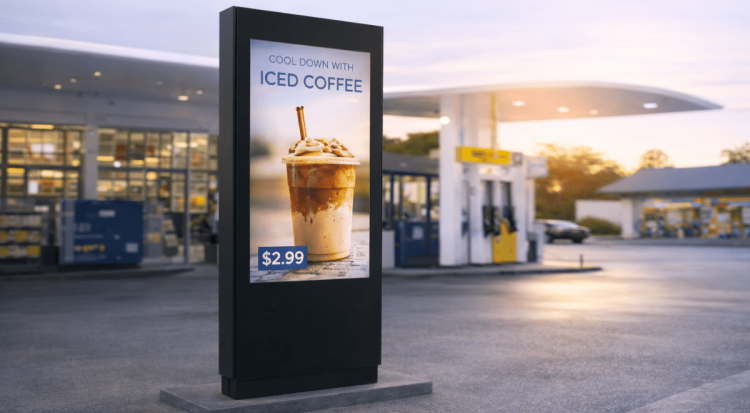
For example, a petrol station screen can display coffee ads in the morning or cold drinks in the afternoon, based on time and conditions, not personal data.
This approach delivers relevance without intrusion.
Context is the New Targeting
As personal targeting declines, contextual relevance is becoming more important.
DOOH excels in this area because it reaches audiences based on:
- Where they are
- What they are doing
- The environment they are in
In high-dwell environments such as petrol stations, consumers are:
- Stationary
- In a purchasing mindset
- Open to immediate action
In mining environments, audiences are:
- Consistent and predictable
- Engaged with their surroundings
- Exposed to repeated messaging over time
By aligning messaging with these contexts, brands can achieve strong engagement without needing to know who the individual is.
Scalable Reach Without Compromising Privacy
One of the biggest advantages of DOOH is its ability to deliver scale while remaining privacy-compliant.
Advertisers can reach:
- Thousands of motorists daily at petrol stations
- Entire workforces across mining sites
- Regional and remote communities often missed by digital channels
All without collecting or using personal data.
This makes DOOH an attractive option for brands looking to future-proof their media strategies.
Integration with the Broader Media Mix
DOOH does not operate in isolation. It can be integrated with other channels to create a cohesive campaign.
For example:
- A DOOH campaign builds awareness in the physical world
- Mobile or first-party data channels reinforce messaging digitally
- Campaign performance is measured through aggregated insights
This allows brands to maintain effectiveness while respecting privacy boundaries.
As first-party data becomes more valuable, DOOH can act as a powerful top- and mid-funnel channel that feeds into broader marketing efforts.
Trust and Brand Perception
Privacy is not just a regulatory issue. It is also a brand issue.
Consumers are becoming more aware of how their data is used, and this is influencing trust.
Advertising that feels intrusive or overly targeted can create negative perceptions. In contrast, DOOH is:
- Non-invasive
- Environmentally relevant
- Seen as part of the physical space rather than personal tracking
This helps brands maintain a positive relationship with their audience.
In a privacy-first world, trust is becoming a key differentiator.
The Shift Toward Sustainable Advertising
The move away from cookies is also encouraging brands to think more sustainably about their advertising strategies.
Rather than chasing individuals across multiple platforms, advertisers are focusing on:
- High-quality environments
- Meaningful engagement
- Efficient reach
DOOH supports this shift by delivering:
- Strong visibility
- High attention levels
- Reduced reliance on complex data ecosystems
This makes it a more sustainable and future-ready channel.
What This Means for the Future
The cookieless future is not a distant concept. It is already here.
As the industry continues to evolve, we can expect:
- Increased investment in DOOH networks
- Greater emphasis on contextual and location-based targeting
- More integration between physical and digital channels
- Continued focus on privacy and compliance
Brands that adapt early will be better positioned to navigate this new landscape.
Final Thoughts
The decline of third-party cookies is reshaping advertising, but it is also creating new opportunities.
DOOH offers a powerful alternative. It delivers relevance without relying on personal data, combines scale with context, and aligns with the growing demand for privacy-first solutions.
For advertisers looking to stay effective in a changing world, the question is no longer how to replace cookies. It is how to build smarter strategies around channels that are designed for the future.
DOOH is one of those channels, and its role is only set to grow.